

By Ward van Gasteren
One of the first growth hackers in Europe, Author of 'Growing Happy Clients', and freelance Growth Consultant.


Growth Hacking was born to find cheap, scalable growth. By 2026, most of its classic tricks are dead. Here's what changed, what never will, and what to do about it.
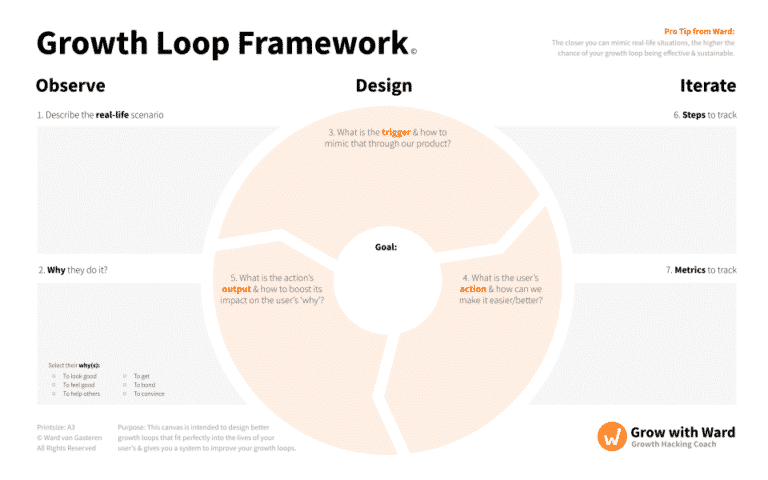
Growth Loop Framework
Map the self-reinforcing loops that compound your growth — free Slides template.
How has growth hacking changed in 2026?
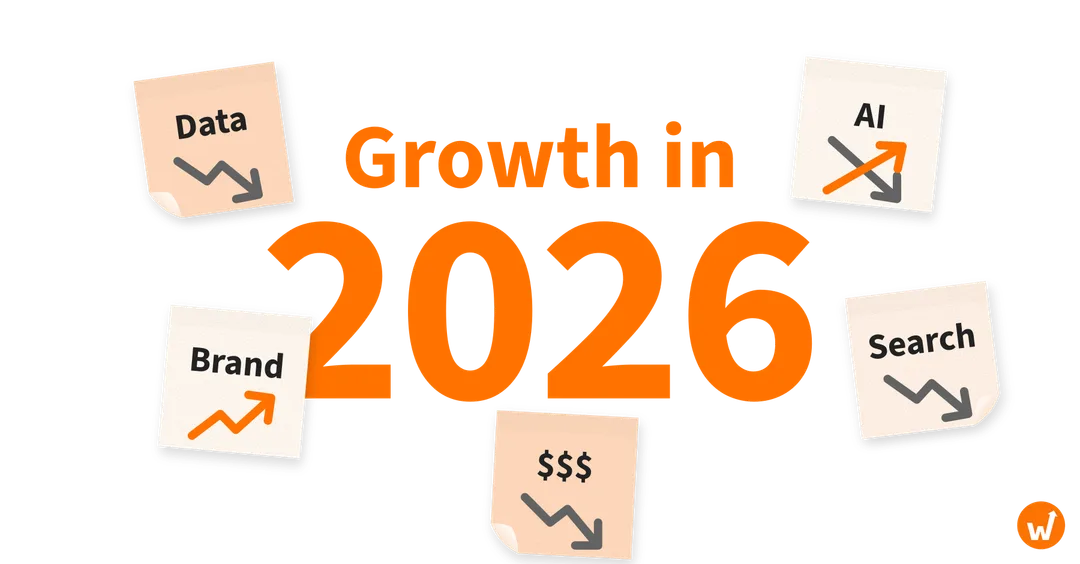
On one hand creating/building/launching got cheap, but getting it found/going viral/finding quick traction got super hard. There are five main trends that have had a big impact on growth hacking/growth marketing:
- Attribution data got removed
- AI made work faster but not better
- We've lost all control over Search as a scalable channel
- Almost every channel went zero-click
- Paid ads convert worse at a higher cost
At the same time some things have never changed, so growth hacking isn't dead for sure, but you need to look at it through a longer-term lens.
Growth Hacking in 2026 vs when it started
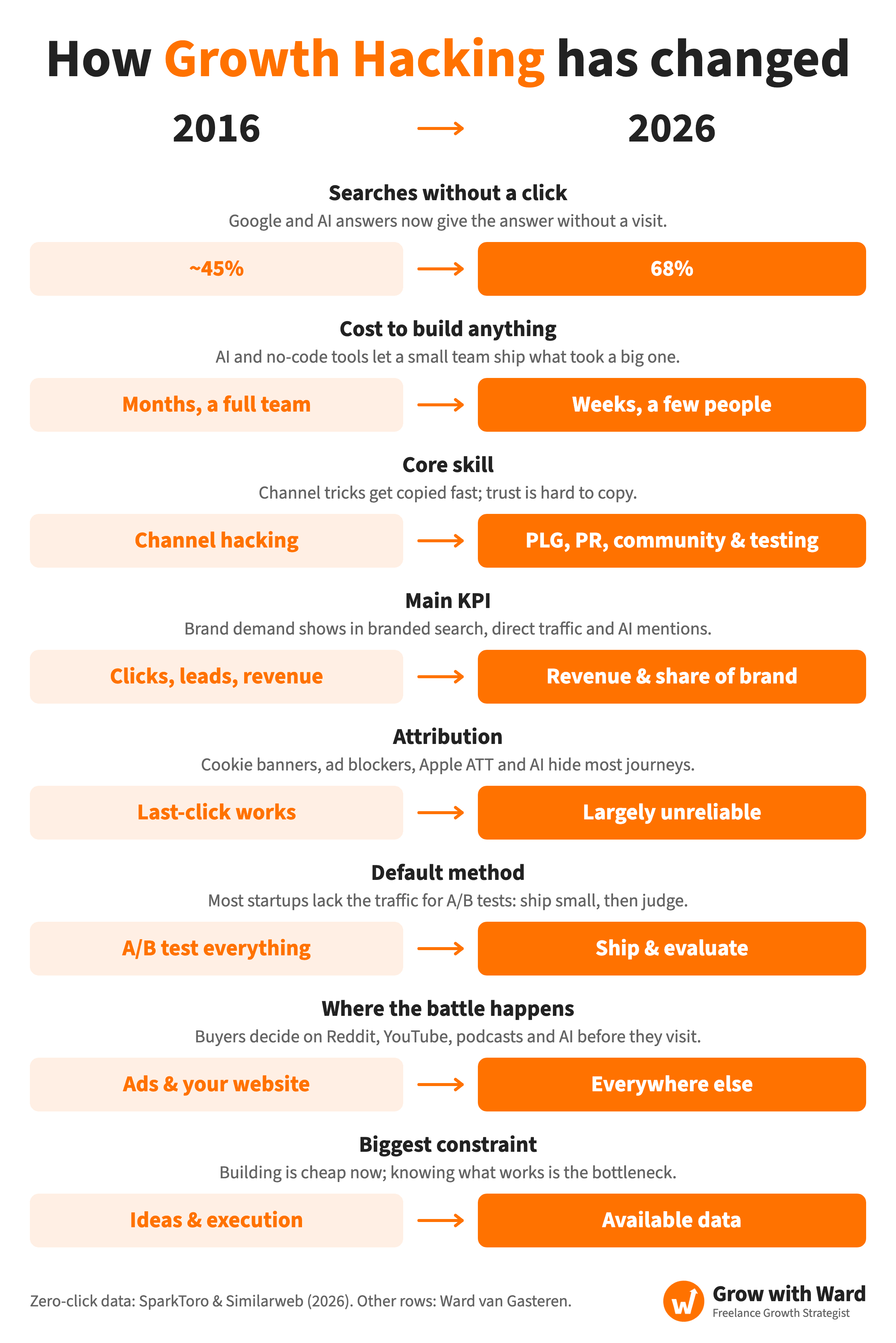
Ten years ago, growth hacking or growth marketing meant finding untapped channels and A/B testing everything. In 2026, it means building a scalable product/brand, getting mentioned where your buyers ask questions, and making decisions with much fuzzier data.
| State of Growth Hacking | 2016 | 2026 |
|---|---|---|
| Searches without a click | ~45% | 68% |
| Cost to build anything | A team and months of work | A few people and a few weeks |
| Core skill | Channel operations & hacking | PLG, PR, community & testing |
| Main KPI | Clicks, leads and revenue | Revenue & share of brand |
| Attribution | Last-click mostly works | Largely unreliable |
| Default method | A/B test everything | Shipping & evaluating |
| Where the battle happens | Ads & your own website | Everywhere else |
| Biggest constraint | Ideas & execution | Available data |
The data provider behind the zero-click numbers changed several times in ten years, so trust the direction more than the exact jump. Source: SparkToro and Similarweb, 2026.
The shift behind every change: cheap to build, almost impossible to be found
Every growth trend in 2026 comes from one asymmetry: building a product/content got close to free, while getting discovered got more expensive.  Dan Layfield, former growth lead at Codecademy, says a 2-person team with AI can now ship in a week what took 200 people a year.
That's where I actually get optimistic: I've noticed that where I would previously run 12-15 experiments per quarter per client, I now easily run 20-30 experiments in the same window. I think that is one of the big opportunities: startups that still want to learn, can now learn a lot faster, because running experiments got so cheap.
But the bill moved to distribution. Getting found now costs more than getting built, and each trend below is that same bill arriving through a different door. So any growth strategy for 2026 starts with distribution, not product.
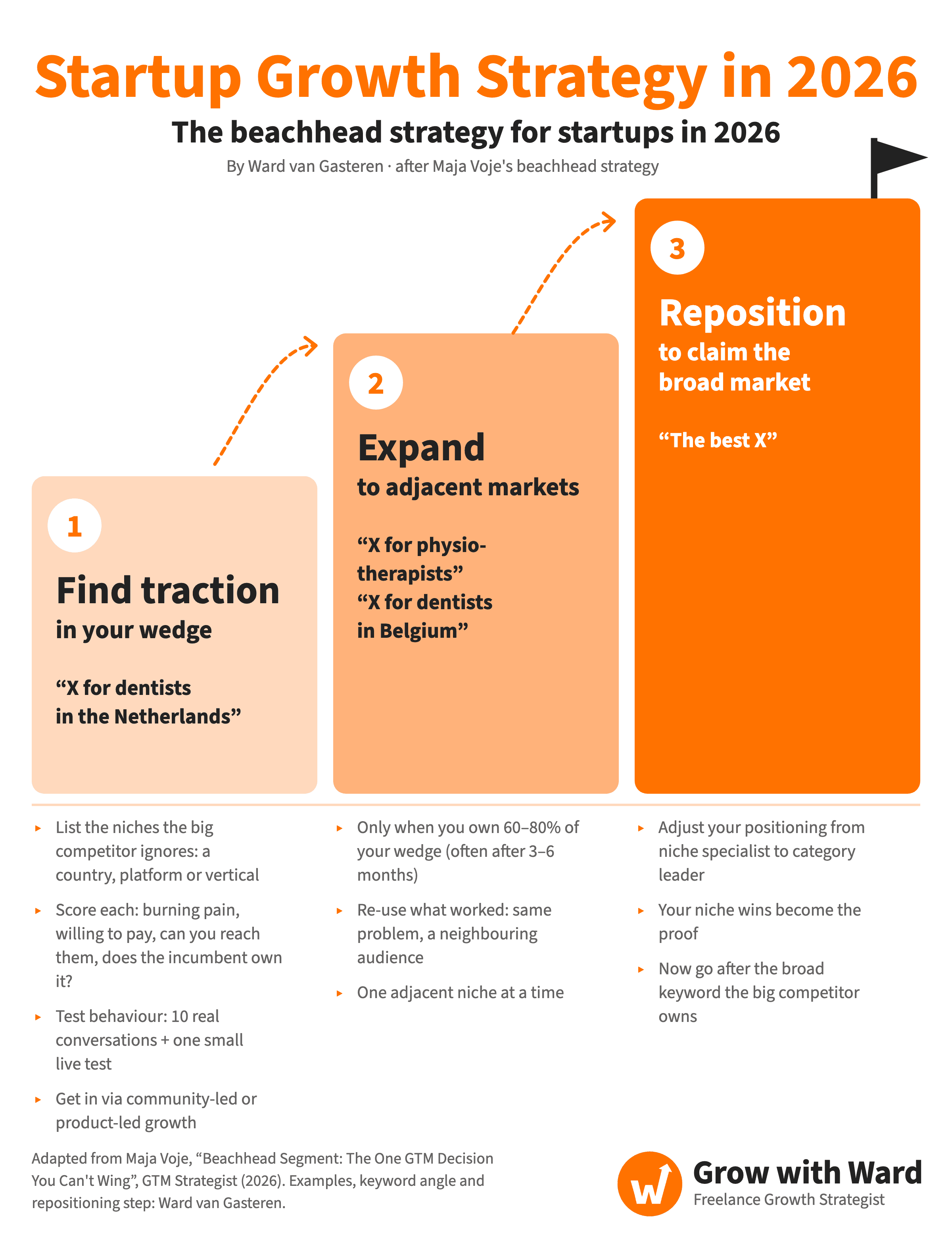
Therefore I think that basically any startup starting nowadays needs to focus on finding a wedge of a specific gap left by big competitors where a focused newcomer could still come in using community-led growth or product-led growth.
 Maja Voje calls this your beachhead segment: win one niche first, then expand.
What changed: 5 growth hacking trends for 2026
The five biggest growth hacking and growth marketing trends in 2026 are: less tracking data, AI that speeds up work without improving results, search that stops sending clicks, brand demand replacing clicks as the KPI, and paid ads that convert worse per click.
I checked each one against primary sources. Four held up, and one I had to correct.
Trend #1: Data-driven decisions got taken away from you
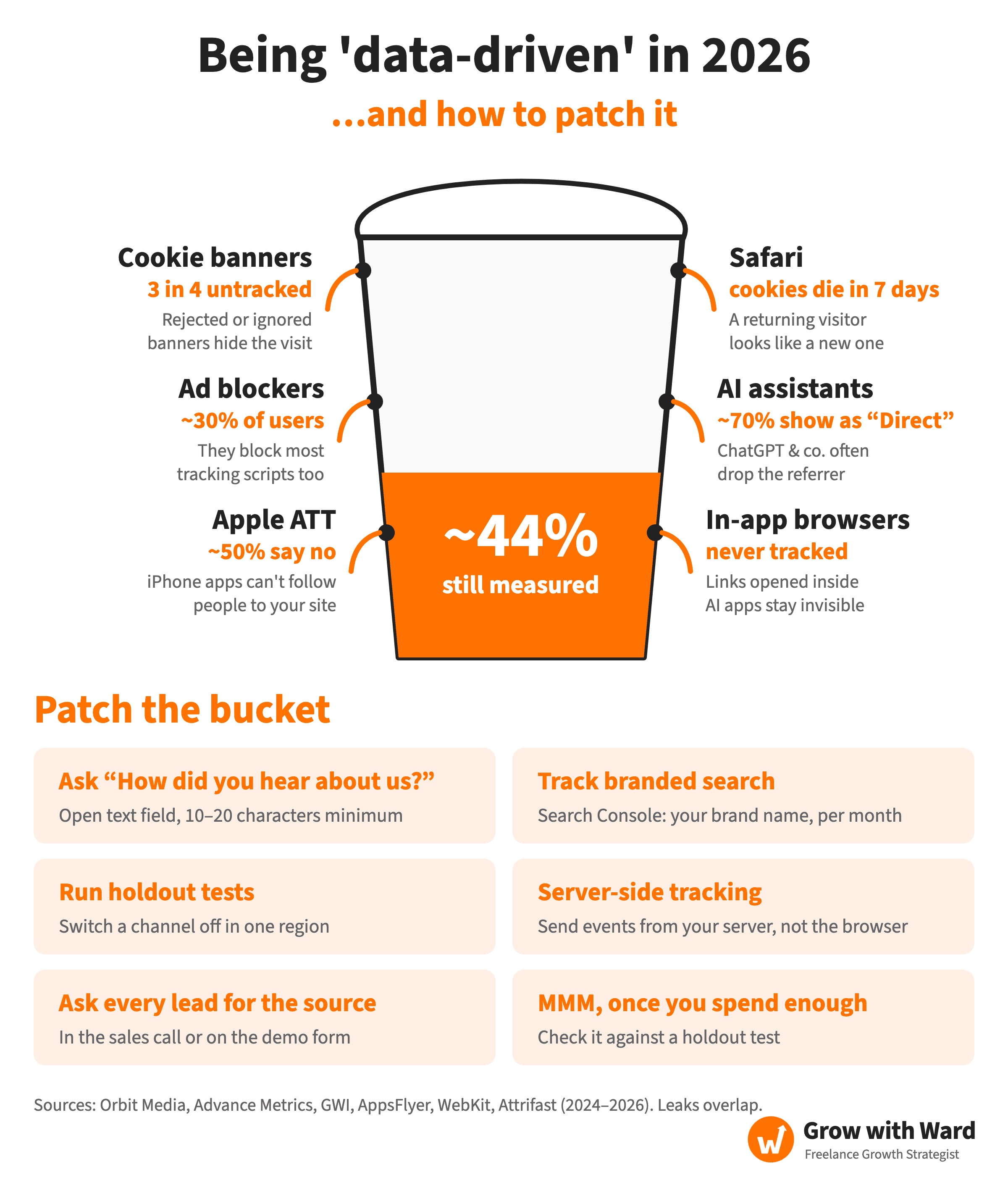
Privacy rules took away most of the tracking data growth teams relied on, and small companies were hit hardest. After Apple's App Tracking Transparency, e-commerce firms that depended on Meta ads lost about 37% of revenue, and small firms lost far more than large ones (Aridor et al., Management Science).
Most of this was decided in courtrooms and browser updates, not in marketing teams. The platforms that already own first-party data (data people give them directly) came out stronger.
Then comes the trap almost nobody mentions. GA4 only estimates the visitors who reject cookies once you have 1,000+ such events a day for seven days; below that, those visitors simply vanish from your dashboard. 🤯
And nowdays people use AI bots to discover the web, but almost all tracking tools simply block those AI bots as being spam, while it's actually users, but they're all seen a 0.01 seconds on your page, or users using the in-LLM browsers of OpenAI/Claude are not even tracked at all by your analytics tools...
What to do
- Small site? Add a "How did you hear about us?" field to your signup or checkout. Messy, but it catches the podcast mentions and WhatsApp forwards your analytics never will. My tip: use an open text field, not a dropdown, and set a minimum of 10–20 characters so people must type a short story - this is the data that traditional tracking can't give you.
- Bigger budget? Test any marketing mix model (MMM: a model that estimates each channel's impact from spend and sales) against one geo holdout: switch a channel off in one region and compare. Or turn off one channel, while doubling the other, and reverse it the next week.
- Stay critical. The popular free MMM tools are either built by Google and Meta, so they aren't really a neutral referee, or the MMM tools are also just inflating the small percentage of traffic that they do know for sure, but therefore missing a lot too.
Related: how to track your growth experiments.
Trend #2: AI made growth work cheaper, not better
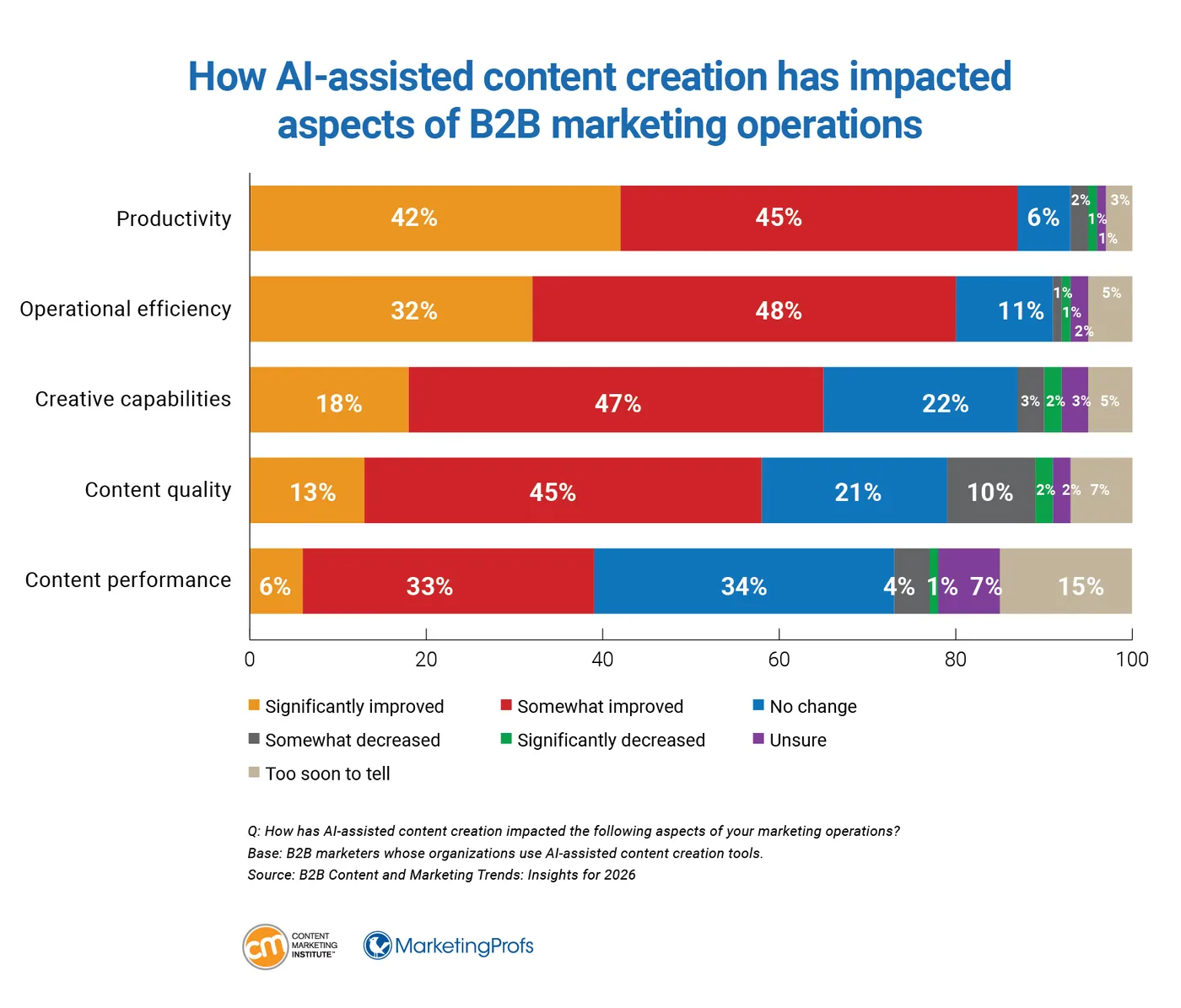
AI made growth work faster, but not more effective. 87% of B2B marketers say AI boosted their productivity, yet only 6% say it significantly improved their content performance (Content Marketing Institute; MarketingProfs, 2025).
The reason is simple: when every competitor gets the same tool on the same day, nobody gets an edge. And mostly-AI articles stopped growing at about half of all new content, because they barely show up in Google or ChatGPT (Graphite, 2026).
What to do
- Use AI for speed on the work that isn't your edge, while doubling down your internal resources on working on the parts that do make your startup unique.
- Experiments are now so cheap, that your experiment velocity should be double what it used to be. I now run 20-30 experiments per quarter with clients, instead of 12-15 in the samen window before AI. This doesn't mean a higher quality = higher winrate, but it's simply a higher volume with the same winrate, thus giving me more wins in the same time.
- Go narrower than feels comfortable. What I always tell founders in my calls, is that ChatGPT writes "10 email marketing tips" in eight seconds, but "What Spotify's onboarding emails get right" only gets written by someone with an opinion.
- Try video. Text became free to produce, so a real person on camera faces far less competition than one more blog post.
Related: the growth hacking tools I actually use.
Trend #3: Search stopped being a channel you control
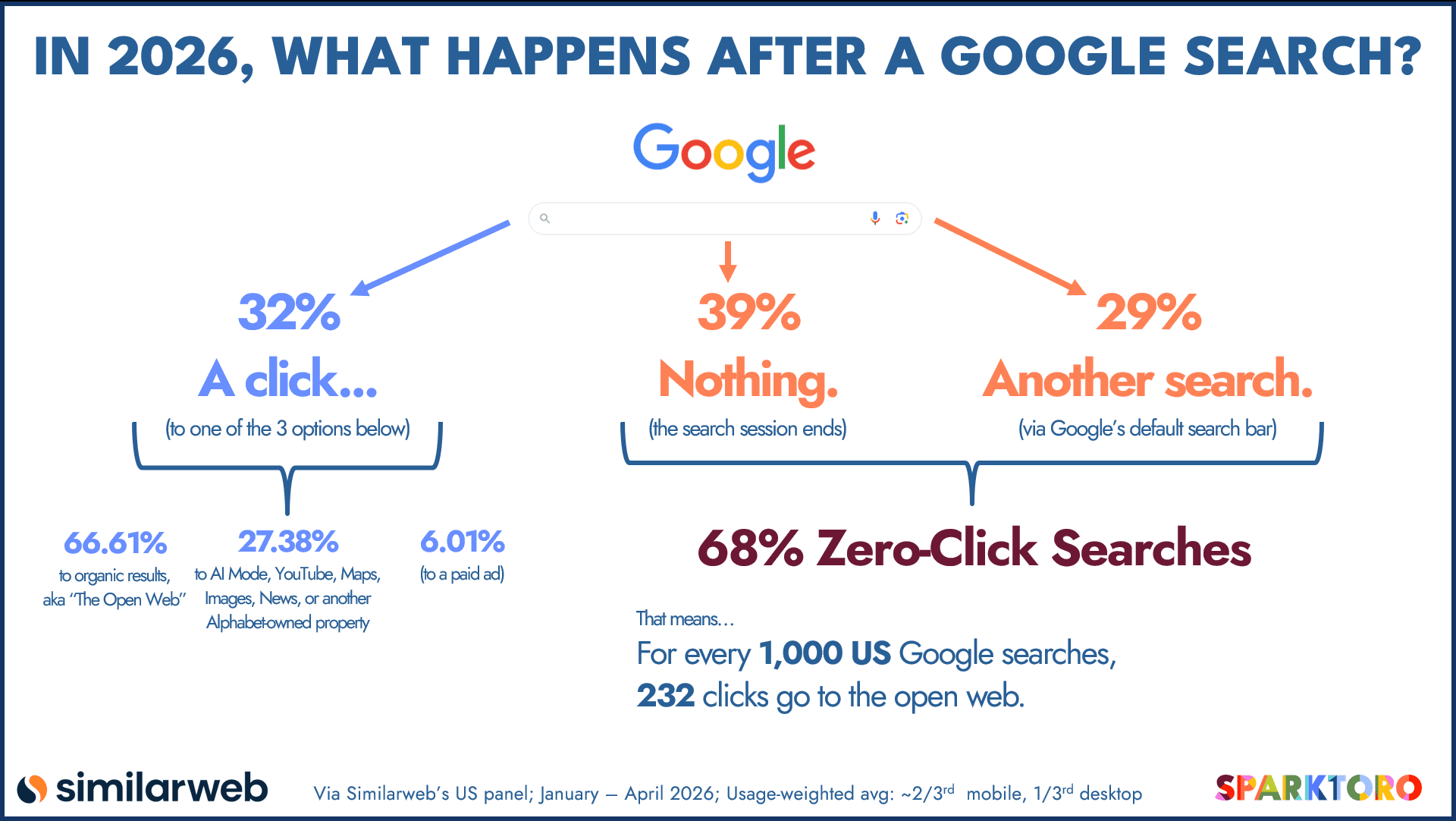
Google and ChatGPT stopped sending people to websites and started answering questions themselves. 68% of US Google searches now end without a click, and only 6.8% of US ChatGPT answers cite a source (SparkToro; Similarweb, 2026).
I see it on my own site: the background queries AI tools run to fact-check (fan-out queries) brought my pages 393,586 impressions in 3 months, but only 24 clicks, while ranking on position 3.4. I estimate that around 28% of my SERP impressions in Search Console are just fan-out queries.
To me, SEO was the most stable channel that you could have, but it's no more - it's not at all what I would recommend nowadays for a startup.
Your AI visibility is mostly earned off your own site, too. Reddit and YouTube are the most-cited sites in Google's AI Mode (Ahrefs, 2026), which makes honest GEO (generative engine optimisation) look like PR and community-led growth wearing an SEO name badge.
What to do
- List the top 10 questions your customers ask before they buy.
- Find a systematic way to ask in ChatGPT, Perplexity and Google, several times, and write down which sources get cited. Ask it from different persona-perspectives and with different framings, and over time it gives you a picture of whether you're improving or losing. I've build my own GEO simulator in Claude Code just to test this with clients.
- Show up where your customers look: that Reddit thread, that YouTube channel, that comparison article.
- Go more niche: Maybe your big competitor is leading the broader 'Best [software]'-keyword, but you can still win the smaller variations '... in the Netherlands', '... for iPhone', or '... for dentists'.
Trend #4: Almost every channel went zero-click
Almost every place you can promote a brand now keeps people on its own platform: Google, ChatGPT, LinkedIn, Instagram, TikTok, YouTube and podcasts. On LinkedIn, one external link cuts a post's median reach by about 19% (Richard van der Blom, 1.3M posts).
It's not a bug, it's the business model: every platform earns from attention, and a click to your website is attention leaving. So the click isn't the main character anymore, and staring at it alone is a case of funnel vision.
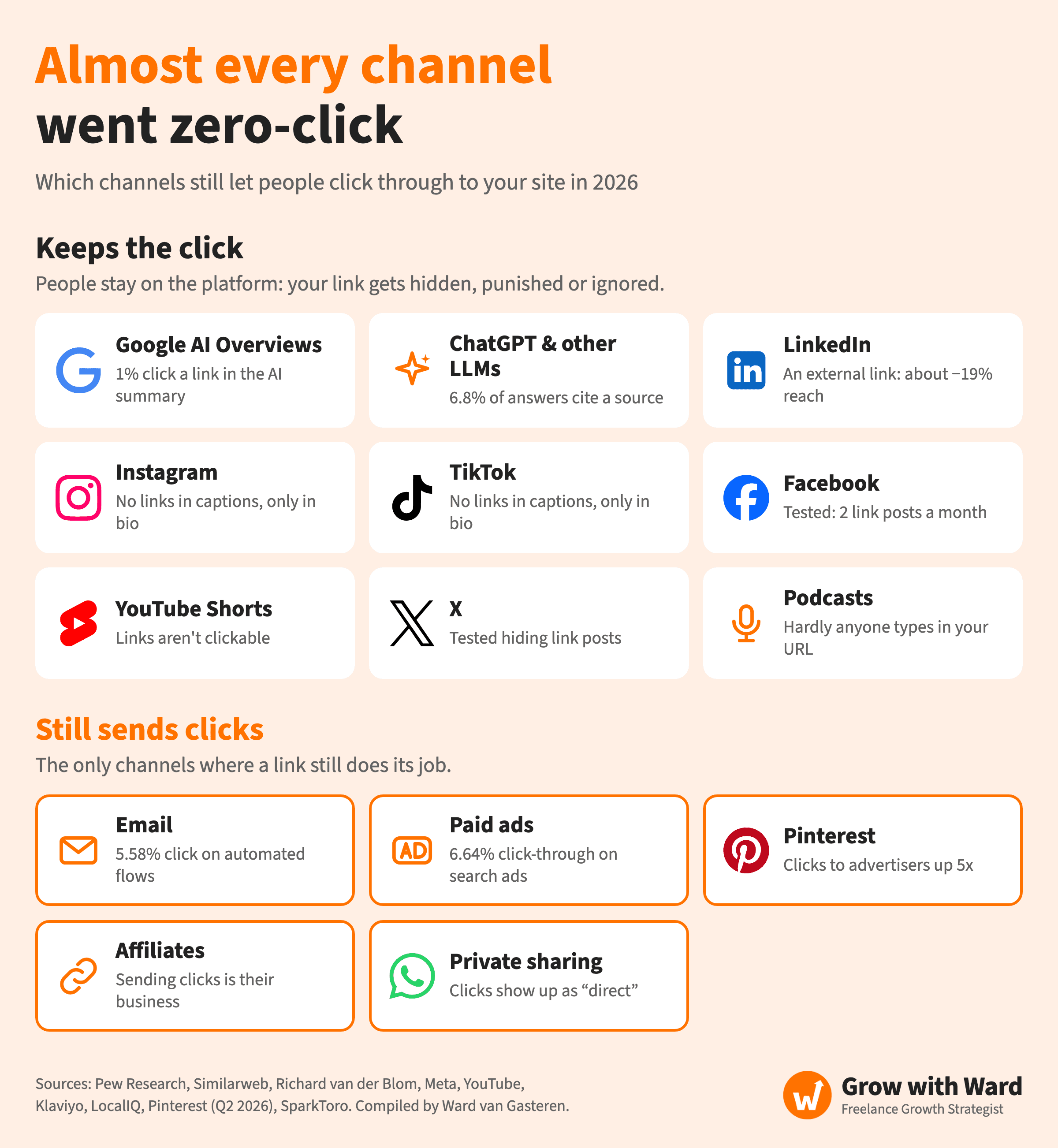
The only channels that still send clicks
- Email: your own list still clicks, at 5.58% on automated flows and 1.69% on campaigns (Klaviyo, 2026).
- Paid ads: you pay per click, so you get clicks: search ads average a 6.64% click-through rate.
- Pinterest: built to send people out, with clicks to advertisers up 5x in three years.
- Affiliates: ... because that's the name of the game for them 🤷♂️
- Private sharing: WhatsApp, Slack and DMs do drive clicks, but they show up as "direct" traffic, so that's also a dark funnel out of your control.
The winners in a zero-click world are brands. When Google shows an AI Overview, branded searches gain 18.68% in click-through while generic searches lose 19.98% (Amsive, 700,000 keywords).
'Tricking an LLM' into mentioning you, like we used to be able to trick Google into ranking us 1st in search, isn't a thing anymore: Even if all the affiliate articles would put you first, you won't get recommended first if objective third party sources like review sites and people posting online aren't positive about you.
What to do
- Build one channel you own: an email list is the last place where a link reliably gets clicked.
- Put the value inside the post: write for the platform, not for the link, and send people to your profile or newsletter instead of a URL.
- Focus on brand and the traffic will come: branded search volume, share of voice (how often you're mentioned vs competitors) and how often AI answers cite you. Those are your growth KPIs now.
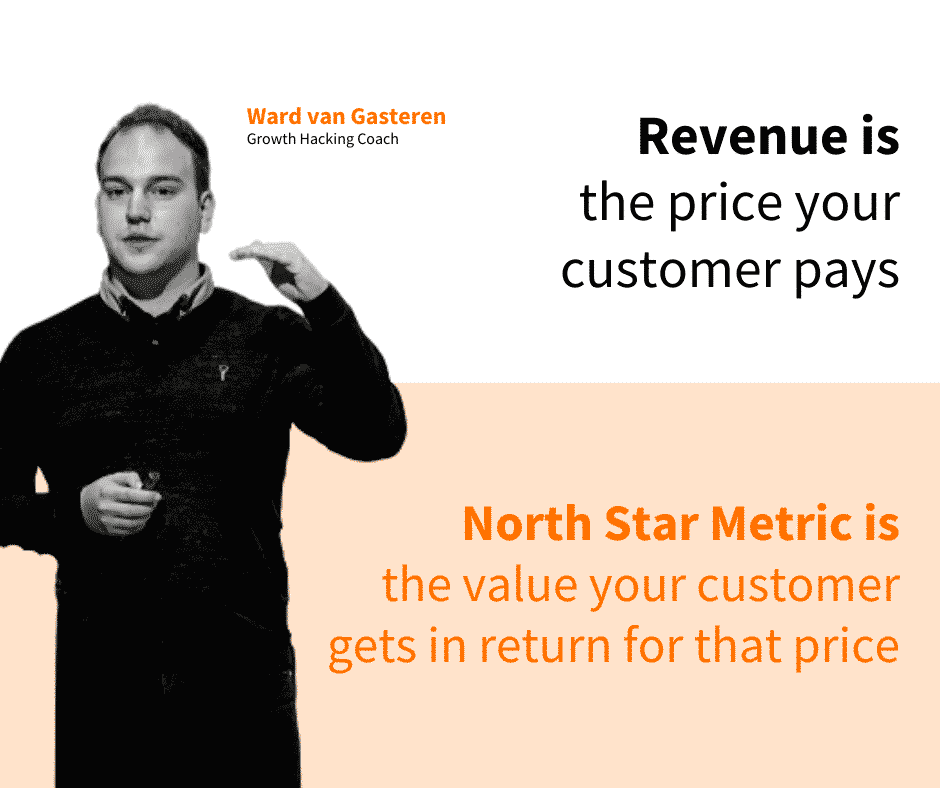
Related: pick your North Star Metric and the One Metric That Matters.
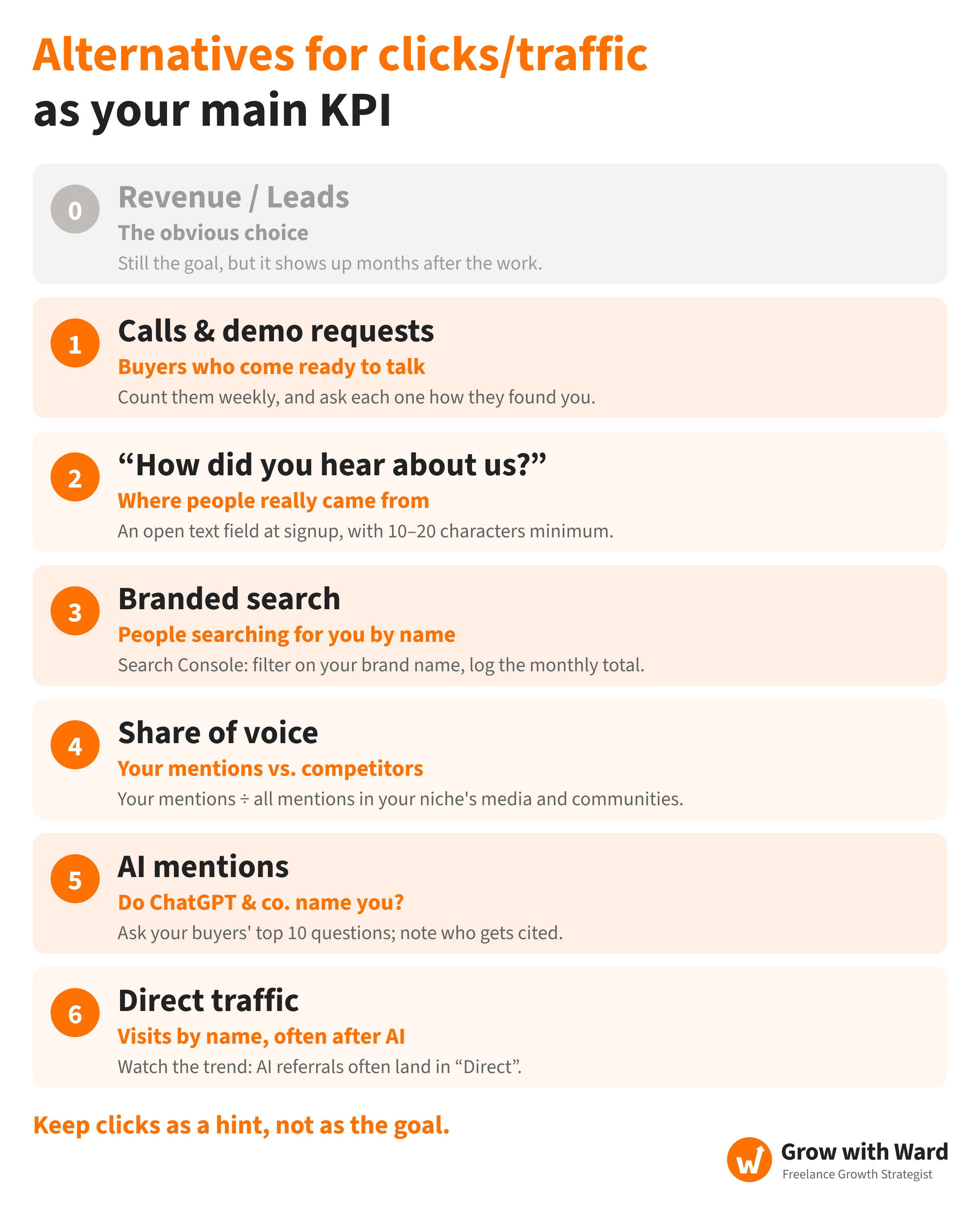
Trend #5: Paid got less effective per click, not more expensive
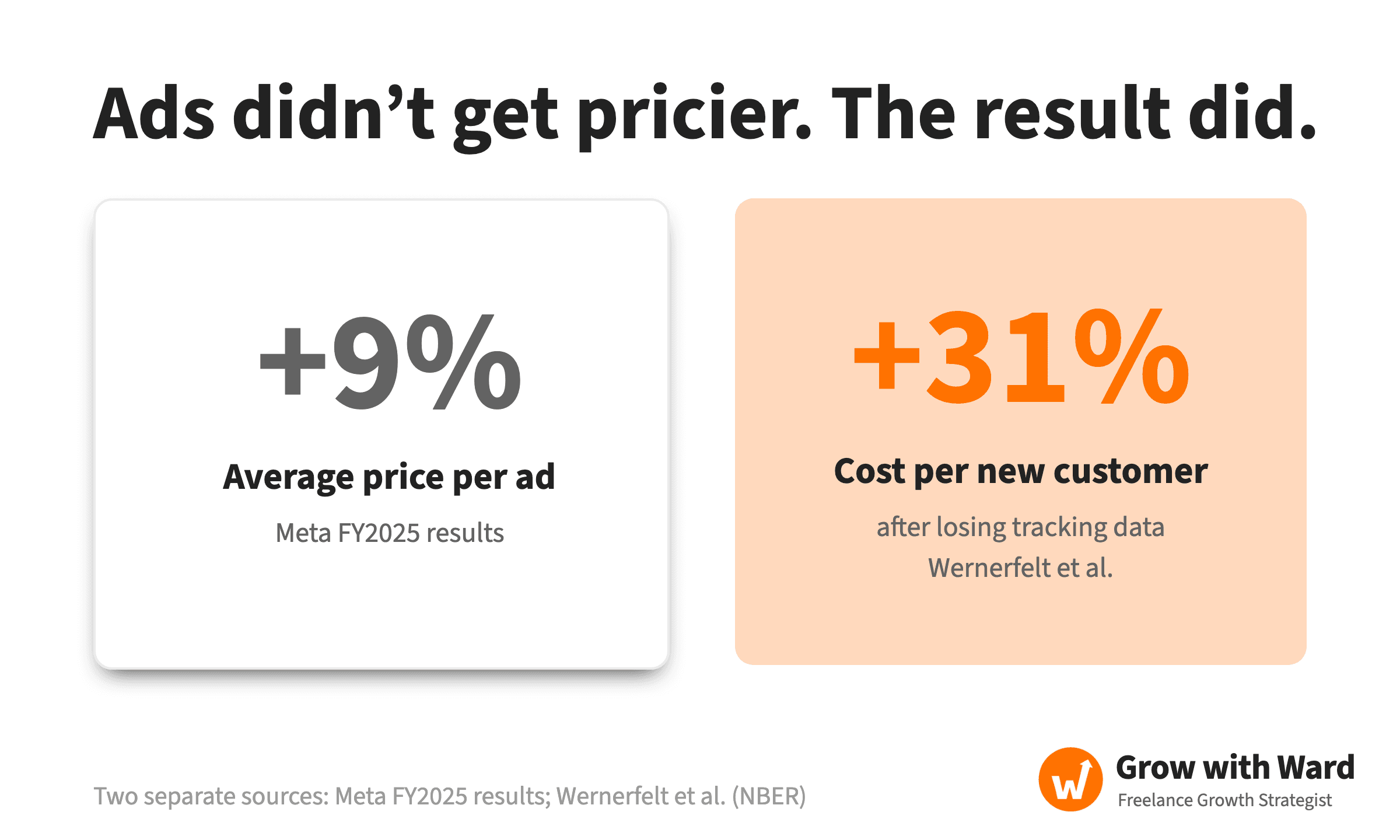
Paid ads didn't get much more expensive per click, they just got worse at converting. Meta's average price per ad rose only 9% in 2025, while losing tracking data raises the cost per new customer by 31% (Meta FY2025 results; Wernerfelt et al.).
When starting this article I even expected that "CPC is rising on every platform" would be the truth, because everybody says it, but there's no real data showing that too. 😬
So your cost per result rises while your cost per click barely moves: pay-per-click quietly turned into pay-per-maybe. I guess people are just harder to impress now that your 20 dollar ChatGPT subscription can already perform miracles.
What to do
- Check in 15 minutes: pull 18 months of CPC and conversion rate for your biggest paid acquisition channel, and see which one actually moved.
- Fix upstream, not in the bidding: collect first-party data, send offline conversions (like closed deals in your CRM) back to the ad platform, and test more creative variations.
3 things in growth hacking that will never change
Three growth principles survived every platform change: customer value comes first, nobody knows upfront what will work, and most tests fail. Almost every dead growth hack died because a platform closed its loophole, not because marketers got worse at it.
'Value created' is still your North Star
Customer value is the only growth strategy no platform update can take away. Hacks that exploit a loophole reach a ceiling pretty quickly; a product people love grows exponentially.
My projects that don't succeed most of the time fail because the founding team is not fully understanding the needs of the audience or more focused on growth versus building something of value. No amount of optimization/hacks can fix that.
 Andrew Chen also mentioned this recently about the big winners of today:
"They don't know anything about funnels, A/B testing, CAC, etc. They just focused on building a killer product."
What to do
- Write down your "aha moment" in one sentence, like "the first time a user sees their own numbers in the dashboard".
- Measure how many new users reach it in their first three days, and improve that number before you add a single new channel.
- First build the best product, and then worry about scaling it.
Related: the North Star Metric and the AAARRR Pirate Funnel.
Still nobody knows what will work, so keep testing
Every marketing channel loses effectiveness as it gets crowded, so growth teams must keep testing new ones. Andrew Chen called this the Law of Shitty Clickthroughs in 2012, and repeated it word for word in 2025.
Even if we'd put the smartest startup people in the same room, they won't get success on their first tries; being open to not being right, is what gives you that innovative mindset of always improving.
What to do
- Keep one backlog of growth experiment ideas and score them with ICE (impact, confidence, ease).
- Test one new channel or angle every month, especially while your current channel still performs.
- Revisit your 'Ease' column in your backlog; I notice that many ideas that were 'basically impossible to run small' is now just a screenshot to Claude and it's ready to ship.
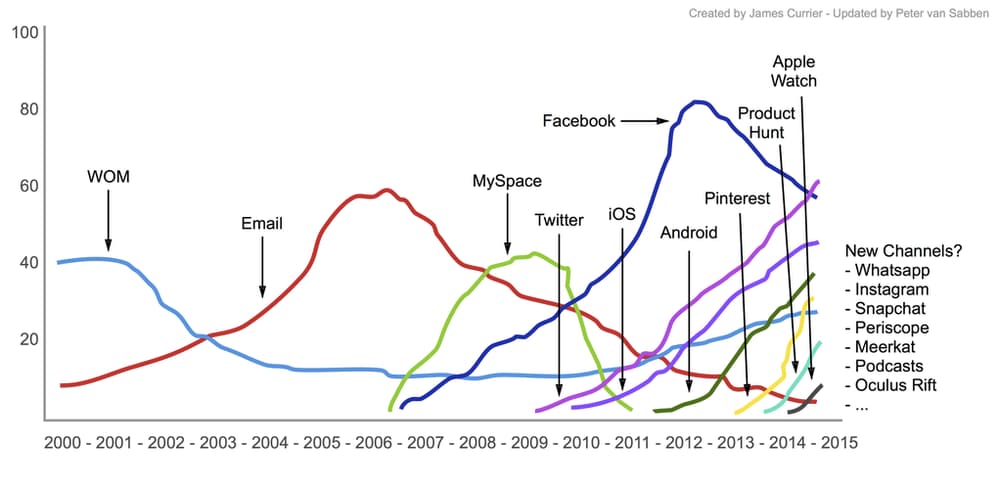
Keep your bets small, because our experiments are still failing
Most growth experiments fail, and that has never changed: Booking.com sees roughly 1 in 10 tests succeed - and with my early-growth startup/scaleup clients I notice a 1 in 3 success rate.
My own projects run on fast cycles, often around ten one-week iterations in a 12-week engagement. Bets that take months before you learn anything, I see as the dangerous ones.
 Elena Verna says she used to spend about 5% of her time innovating on growth and 95% optimising, and now it's the other way around. As she puts it:
"It's now becoming cheaper to just try something than to debate it."
I personally always cap experiments for clients on 2 days maximum: if you expect 2 in 3 experiments to fail, then you shouldn't allow yourself to waste more than 2 days on an idea that you haven't validated yet.
What to do
- Ask "what's the smallest version I can ship this week?" instead of "what should this look like?"
- Ship it imperfect on purpose and let the reaction decide if it deserves a version two.
- Remember: ten conversations where nobody cares is a finished experiment, not a failed one.
Related: the growth hacking mindset and the G.R.O.W.S. process.
Download the full cheat sheet with examples (PDF)
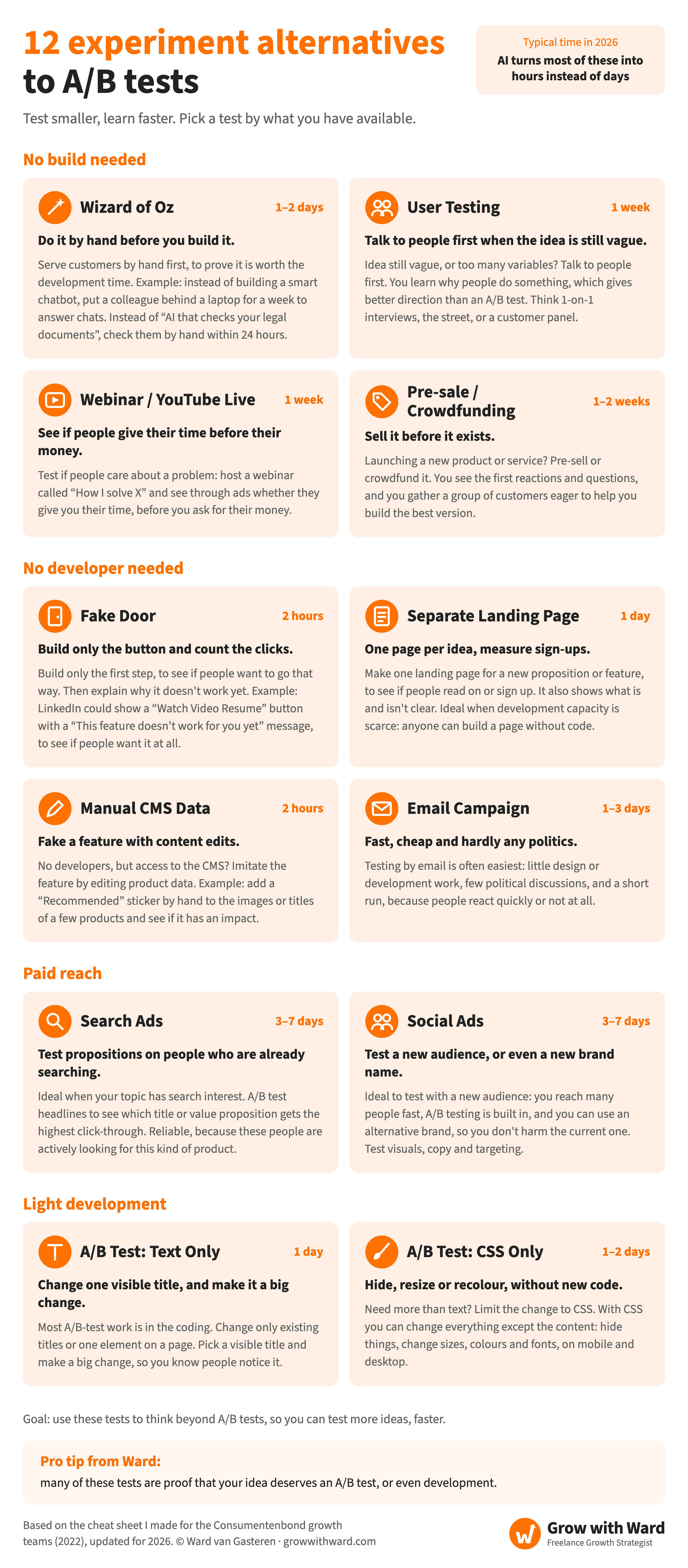
My conclusion
Growth hacking didn't die, but the short-term results from quick experiments are definitely gone: paid ads and quick boosts have become less effective, while the upside on long-term growth loops, a well-played brand/content game and a strong growth strategy has become tremendously stronger. So the foundations of experimenting, understanding customers and finding the bottleneck still carry you.
FAQ about Growth Hacking 2026
What are the biggest growth hacking trends in 2026?
Five: less tracking data for feedback loops, AI that speeds up all work, search is almost impossible to game, brand demand replacing clicks as the KPI, and paid ads that convert worse per click.
Is growth hacking dead in 2026?
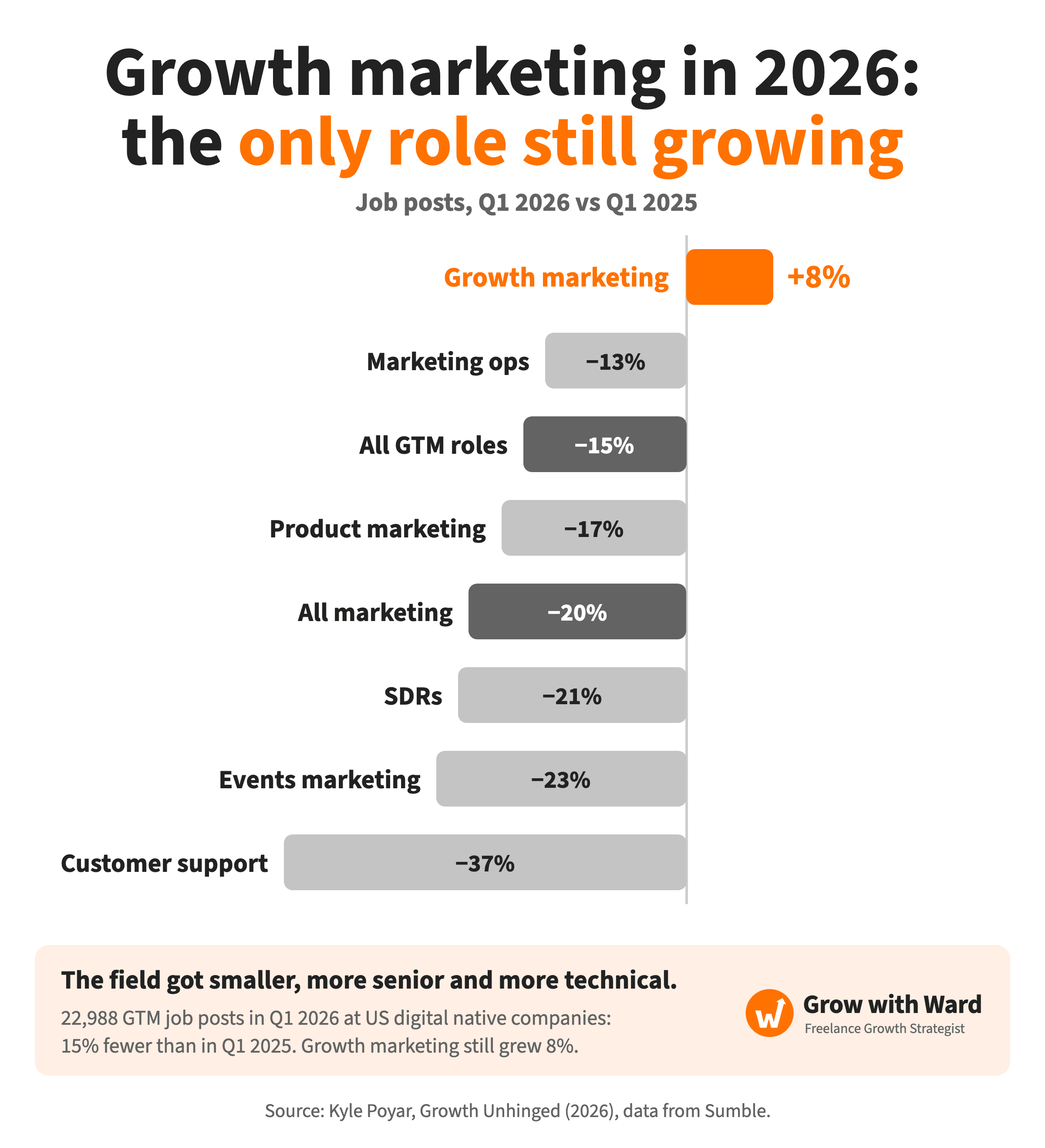
No. Go-to-market job postings fell 15% year on year, but growth marketing was the only marketing role that grew ( Kyle Poyar with Sumble data, 22,988 posts). The field got smaller, more senior and more technical.
What are the best growth hacking techniques for startups in 2026?
Niche focus, a product that shows value within days, and being mentioned where buyers research: Reddit, YouTube, podcasts and AI answers. Pair that with small, reversible experiments instead of big bets.
Which growth channels work best in 2026?
Channels built on trust: communities, creators, PR, video and product-led loops. Paid still works, but only with strong first-party data, and SEO now wins mostly on branded and very specific searches.
How do you measure growth in 2026 without cookies?
Combine a "how did you hear about us?" field, branded search volume, holdout tests and, at scale, marketing mix modelling. Treat last-click attribution as a hint, not the truth.
Will AI replace growth hackers in 2026?
No. AI makes execution faster for everyone, so it stops being an edge. Judgment, customer insight and picking the right bets become more valuable, not less. So find growth hackers with taste and strategical understanding is the most important.
What skills does a growth hacker need in 2026?
The basics stay: experimenting, customer research and finding the bottleneck. Add brand and PR thinking, community work, basic data and automation skills, and the confidence to decide without perfect data. More in growth hacker skills.
How I checked this article
Built on my own work (150+ clients and 1000+ experiments over the past 12 years) and roughly 140 primary sources: peer-reviewed research, company filings, court documents and publisher data, with vendor research labelled as such.
Four common claims I left out because they don't survive checking: "95% of AI pilots fail", "74% of the internet is AI slop", "cold email reply rates collapsed because of AI" and "LinkedIn organic reach dropped 50%".
About the author
Ward van Gasteren
Ward van Gasteren is one of the first growth hackers in Europe. He has helped 150+ companies run 1000+ growth experiments, wrote the growth-hacking handbook 'Growing Happy Clients', and trains teams across Europe to grow smarter — not just harder.
- Author of 'Growing Happy Clients'
- 150+ clients · 1000+ experiments
- Featured by TedX, TechCrunch & The Next Web
Worked with





Want to learn more?
Check out my other resources or get in touch to discuss how I can help your business grow.
Questions & comments
Got a question about this article? Ask it here — I answer them myself.